US–Israeli War Against Iran (February 28, 2026–Present)
From Talks to War: US and Israel Launch War Against Iran
The Israeli military, together with the US Armed Forces, launched Operation Epic Fury against Iran on February 28, 2026, over the alleged development of a nuclear program by the Islamic Republic.
Iran consistently stated that the program was peaceful in nature, referring to the Treaty on the Non-Proliferation of Nuclear Weapons (NPT), and was ready to freeze uranium enrichment and place its facilities under IAEA control, but refused to completely dismantle its infrastructure. The US, however, insisted on “zero nuclear.”
Donald Trump defined the operation’s objective as the elimination of the “threat” posed by the Iranian regime.
The last round of negotiations between Iran and the US in Geneva on February 26 failed, and within days diplomacy gave way to war.
First Day of War & Killing of Iran’s Supreme Leader
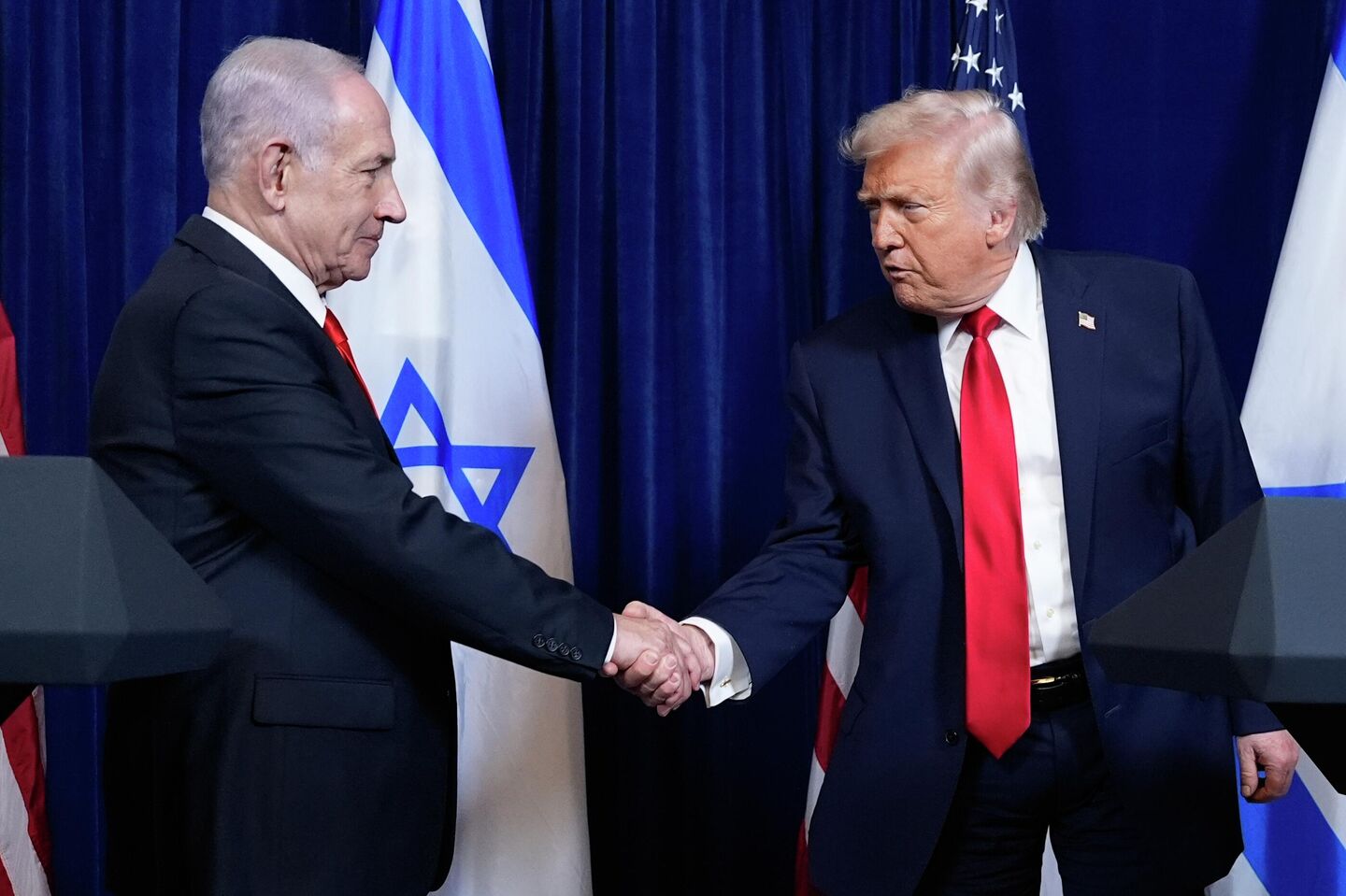
President Donald Trump shakes hands with Israel's Prime Minister Benjamin Netanyahu at the end of a news conference at Mar-a-Lago, Monday, Dec. 29, 2025, in Palm Beach, Fla. (AP Photo/Alex Brandon)
© AP Photo / Alex Brandon
Operation True Promise 4
Iran’s IRGC confirmed the launch of a retaliatory operation called True Promise 4. During the counterstrikes, US and Israeli military facilities located in Bahrain, Jordan, Qatar, Kuwait, the UAE, and Saudi Arabia were attacked.
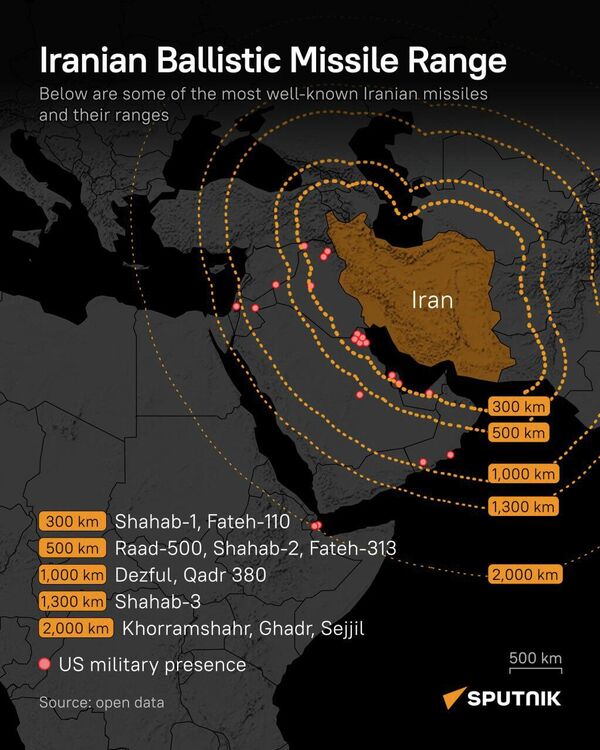
Mapping Iran’s missile reach across Middle East
© Sputnik
According to media reports, at least 80% of Iranian missiles hit their targets during the first wave of strikes against Israel. The IRGC also reported hitting a long-range early warning radar system at a US military base in Qatar.
Tanker traffic through the Strait of Hormuz was completely halted. The IRGC ordered a full closure of the Strait of Hormuz, banning tanker movement. Later, Iranian authorities stated that passage through the strait would be allowed for friendly countries.
Tragedy In Minab, Iran
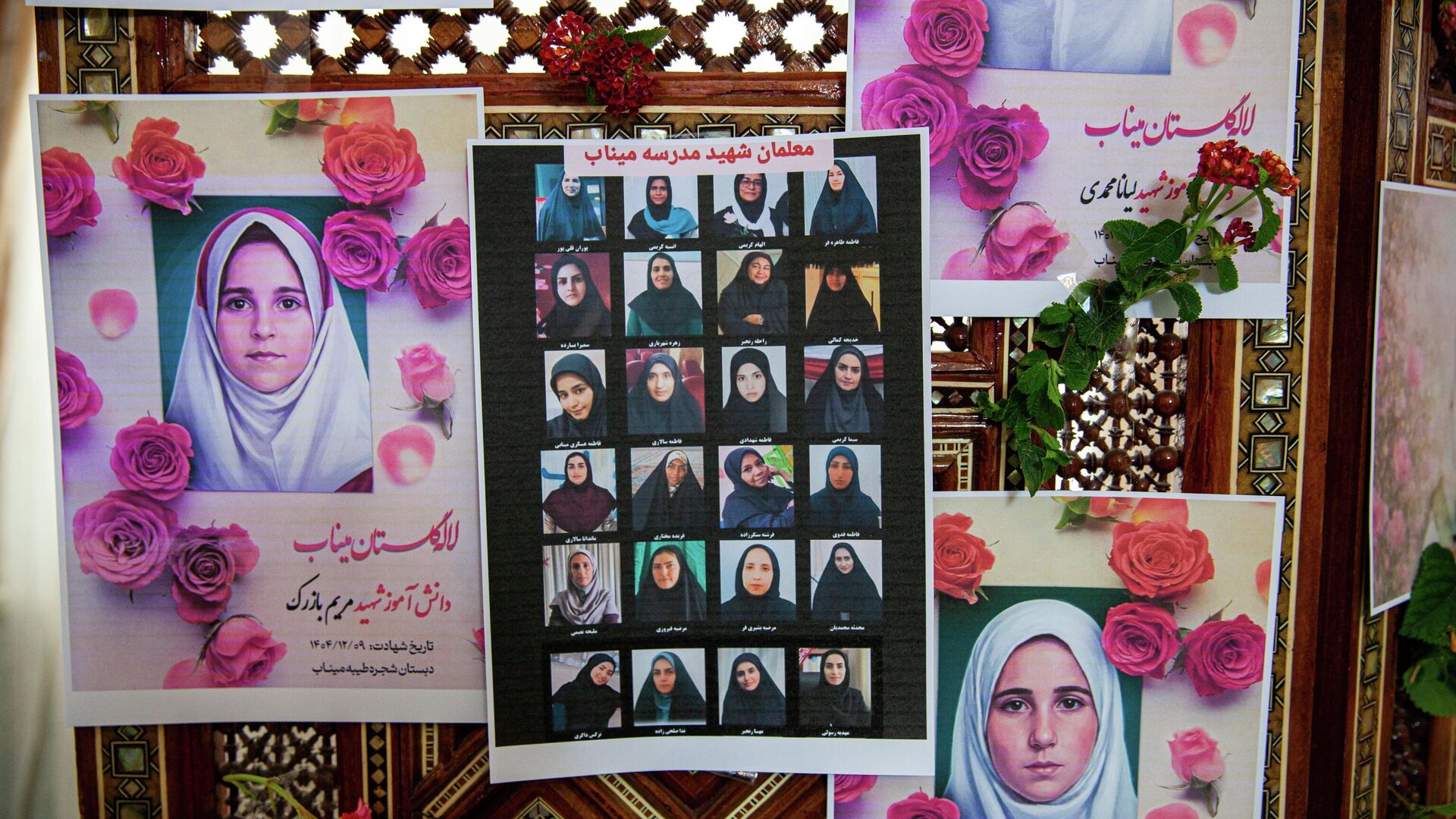
On February 28, 2026, a girls’ primary school was destroyed in a missile strike, becoming one of the most high-profile incidents since the beginning of the military escalation in the region. Two American Tomahawk cruise missiles struck the Shajareh Tayyebeh primary school. According to various reports, between 168 and 175 schoolgirls aged 7–12 were killed, along with teachers, and dozens more were injured.
Leadership Deaths Confirmed
On March 1, Iranian official media confirmed the death of Ayatollah Ali Khamenei, who was killed on the morning of February 28 at his residence.
40-day period of mourning was declared in the country. Among the victims of the US and Israeli attacks were also the ayatollah’s daughter, son-in-law, granddaughter, and daughter-in-law
Deaths of other senior officials were confirmed: Defense Minister Aziz Nasirzadeh, IRGC Commander Mohammad Pakpour, Chief of the General Staff Abdolrahim Mousavi, and advisor Ali Shamkhani
The spokesperson for the Expediency Council announced the selection of Ayatollah Alireza Arafi as a member of the Guardian Council within the leadership body. Ayatollah Arafi is the head of the religious seminaries and a member of the Guardian Council. Masoud Pezeshkian, Hojjat al-Islam Gholamhossein Mohseni Ejei, and Ayatollah Alireza Arafi are members of the Temporary Leadership Council.
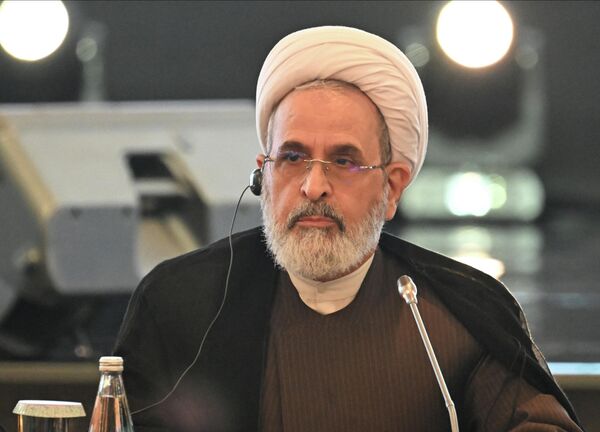
Ayatollah Alireza Arafi, head of Iran’s religious seminaries, member of the Guardian Council, and vice chairman of the Assembly of Experts.
© Sputnik / Maksim Bogodvid
/ Expansion of Conflict
On March 2, 2026, Iran carried out a series of attacks on Israel and US bases in the region, as well as on Erbil Airport in Iraq. Explosions were heard in Dubai, Doha, and Bahrain. The IRGC stated that Iran attacked 60 strategic targets and 500 military sites of the US and Israel, using more than 700 drones and hundreds of missiles.
Iran’s Supreme National Security Council Secretary Ali Larijani officially stated that Iran would not conduct any negotiations with the US.
Hezbollah resumed active combat operations against Israel, stating that the attacks were revenge for the killing of Iran’s Supreme Leader Ali Khamenei. On the same day, Israel carried out strikes on the southern districts and suburbs of Beirut. As a result of the attack, the head of Hezbollah’s parliamentary bloc, Mohammad Raad, was killed.
Israel launched missile strikes on Beirut targeting Hezbollah facilities. Some 31 people were killed and 140 were injured.
US Air Force F-15 fighter jet crashed in Kuwait. Iranian media claimed it was shot down by an Iranian missile, while the US said the F-15 was hit by “friendly fire.”
Regional Attacks and Advanced Weapons
- From March 3 to 10, the IRGC attacked a US airbase in Bahrain with missiles and drones, and also struck Israeli targets: the Army headquarters in Caesarea, sites in Bnei Brak, Petah Tikva, Western Galilee, Ben Gurion Airport, and the Ministry of Defense in Tel Aviv.
- IRGC stated that the attacks had reached a new level with the use of strategic and hypersonic missiles (Ghadr, Emad, Fattah, Kheibar Shekan). The Iranian Aerospace Forces command noted that warheads would now weigh no less than one ton. Iran used its newest heavy missile the Khorramshahr-4 (range—2,000 km, warhead—1,500 kg) against targets in Israel.
- Iran carried out its 22nd wave of attacks using Khorramshahr-4 and Fattah missiles. The IRGC announced the destruction of THAAD missile defense radars in the UAE and Jordan, as well as an AN/FPS-132 radar in Qatar.
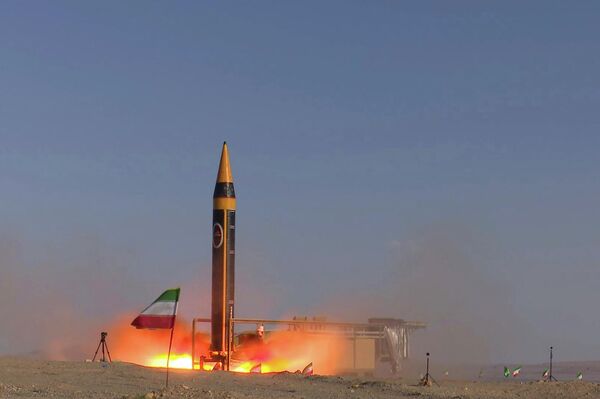
In this photo released by the Iranian Defense Ministry on May 25, 2023, Khorramshahr-4 missile is launched at an undisclosed location, Iran (Iranian Defense Ministry via AP)
© AP Photo
Iranian President Masoud Pezeshkian stated that the country would stop strikes against neighboring states if no attacks were launched from their territory.
Change in Iran’s Strategy
On March 11, 2026, Iran’s Armed Forces announced a change in their war strategy against Israel and the US, as well as in the tactical principles of strikes against targets linked to the aggressors on the territories of Persian Gulf countries. Strikes would now be carried out on a continuous basis and no longer be in response to attacks by US and Israeli forces on Iran.
Hezbollah announced the launch of a new operation against Israel called Eaten Straw, firing 100 rockets from Lebanon into northern Israel. Hezbollah and Iran described it as their first coordinated attack. Iran, together with Lebanon’s Hezbollah, struck more than 50 targets in Israel.
Iran stated its readiness to fight the US for more than 10 years: “A diplomatic solution is now excluded.”
US Uses Advanced Tech and Weapons
- Distinctive feature of the current military operation has been the use of AI technology. As a spokesperson for the US Central Command stated, AI is used for initial data processing to highlight what requires human attention. The decision to select a target and carry out a strike is made by a human.
- US Central Command confirmed the first use of high-precision PrSM (Precision Strike Missiles). The system is a development of ATACMS ballistic missiles, but compared to its predecessor, it can travel 200 km farther. Its range is up to 500 km, and is launched from the HIMARS mobile platform.
- Another debut involved a new development—the LUCAS kamikaze drone. It is a clone of Iran’s well-known Shahed drone. According to media reports, the cost per unit is $35,000.
Global Divide Amid War
Russia’s response was swift: On March 1, Vladimir Putin expressed condolences to Iranian President Masoud Pezeshkian over the killing of the country’s Supreme Leader Ali Khamenei and members of his family, noting that it was carried out in cynical violation of all norms of human morality and international law. Putin also reaffirmed Russia’s principled position on the need for an immediate cessation of hostilities, rejection of violent methods to resolve issues around Iran and across the Middle East, and a prompt return to political and diplomatic settlement.
Germany, France, and the United Kingdom stated they were not involved in the strikes on Iran, but condemned the Iranian strikes.
Italy and Spain showed restraint in their assessment of the situation.
Spanish Prime Minister Pedro Sanchez: The government’s position is “No to war,” after Donald Trump expressed disappointment with Spain over not providing its bases for strikes on Iran.
Italian Prime Minister Georgia Meloni condemned the US and Israeli strikes on Iran during her speech in parliament in Rome. She described the military campaign unfolding in the Middle East as part of a growing trend of unilateral interventions “going beyond international law.”
Reduced Shipping Through Strait of Hormuz & Oil Crisis
Following the US and Israeli strikes on Iran, shipping through the Strait of Hormuz sharply declined, and insurers began raising war premiums and revising coverage amid growing security risks. There is no formal blockade, but the market has faced a de facto paralysis of transport due to security threats.
Strait of Hormuz is a strategically important corridor: About 30% of global liquefied natural gas (LNG) trade and around 20% of oil and petroleum products pass through it. Amid rising risks, major shipping companies from Germany, Japan, France, and other countries have suspended transit through the corridor.
Iran officially stated that it is maintaining its maritime sovereignty in the Strait of Hormuz. The country treats passing vessels in accordance with international protocol, but will “identify” and “not allow to exist” commercial ships used by “other states for military purposes.”
Later, Iran stated that any Arab or European country that expels Israeli and American ambassadors from its territory will receive full freedom and rights to pass through the Strait of Hormuz.
Casualty Summary
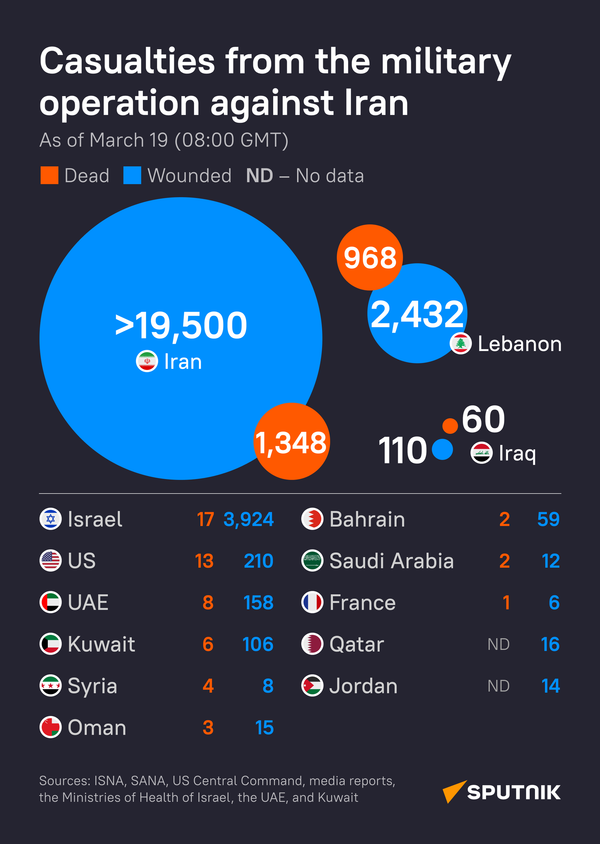
Casualties from the military operation against Iran
© Sputnik
- The conflict had led to heavy human losses and a large-scale humanitarian crisis.
- According to official Iranian data, at least 1,348 civilians have been killed and more than 17,000 people injured. The independent agency HRANA reports higher figures: at least 1,825 dead, including 1,276 civilians, among them 200 children, as well as 197 military personnel.
- Fighting has also affected neighboring countries. In Israel, 12 people have been killed, including four children, as well as two soldiers in Lebanon. Lebanon itself has lost at least 687 people (including 98 children and 52 women) and three military personnel. In the Persian Gulf countries, 24 people have been killed, including 11 civilians and seven US servicemen. In Iraq, 31 people have been killed.
- number of direct deaths across the region has exceeded 2,000. However, the humanitarian catastrophe inside Iran has been even more extensive: according to the UN High Commissioner for Refugees, up to 3.2 million people have been forced to leave their homes, becoming internally displaced persons.
Strike on Elite: Larijani’s Death Won’t Change Iran’s Power Balance
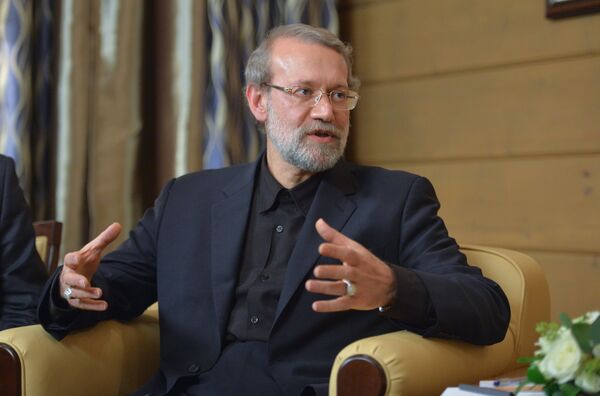
October 22, 2015. Speaker of the Islamic Consultative Council (parliament) of the Islamic Republic of Iran Ali Larijani during a meeting with Russian President Vladimir Putin following the 12th annual meeting of the Valdai International Discussion Club.
© Sputnik / Alexei Druzhinin
/ Iran’s Foreign Ministry called the killing of Larijani a terrorist act and urged the UN Security Council to hold those responsible accountable.
Economic Losses Amid the Conflict With Iran
The first week of hostilities cost the US budget at least $11.3 billion. This was primarily direct expenditures on munitions: in just the first two days, the Pentagon spent $5.6 billion on precision weapons (for example, AGM-154 glide bombs cost up to $836,000 each). The US is spending about $1 billion per day on the war with Iran.
The Trump administration is preparing to request an additional $50 billion from Congress. However, there is no unity within Congress: Democrats are demanding clarification of the strategy, while some Republicans are concerned about uncontrolled spending. Some within the administration believe that even $50 billion is an underestimate.
Oil Market
Rise In Gold Prices
Go back to the beginningGo back to the main page
12:23 20.03.2026
(Updated: 14:57 20.03.2026)