America's Blackmail Diplomacy Risks Backlash From India: Experts
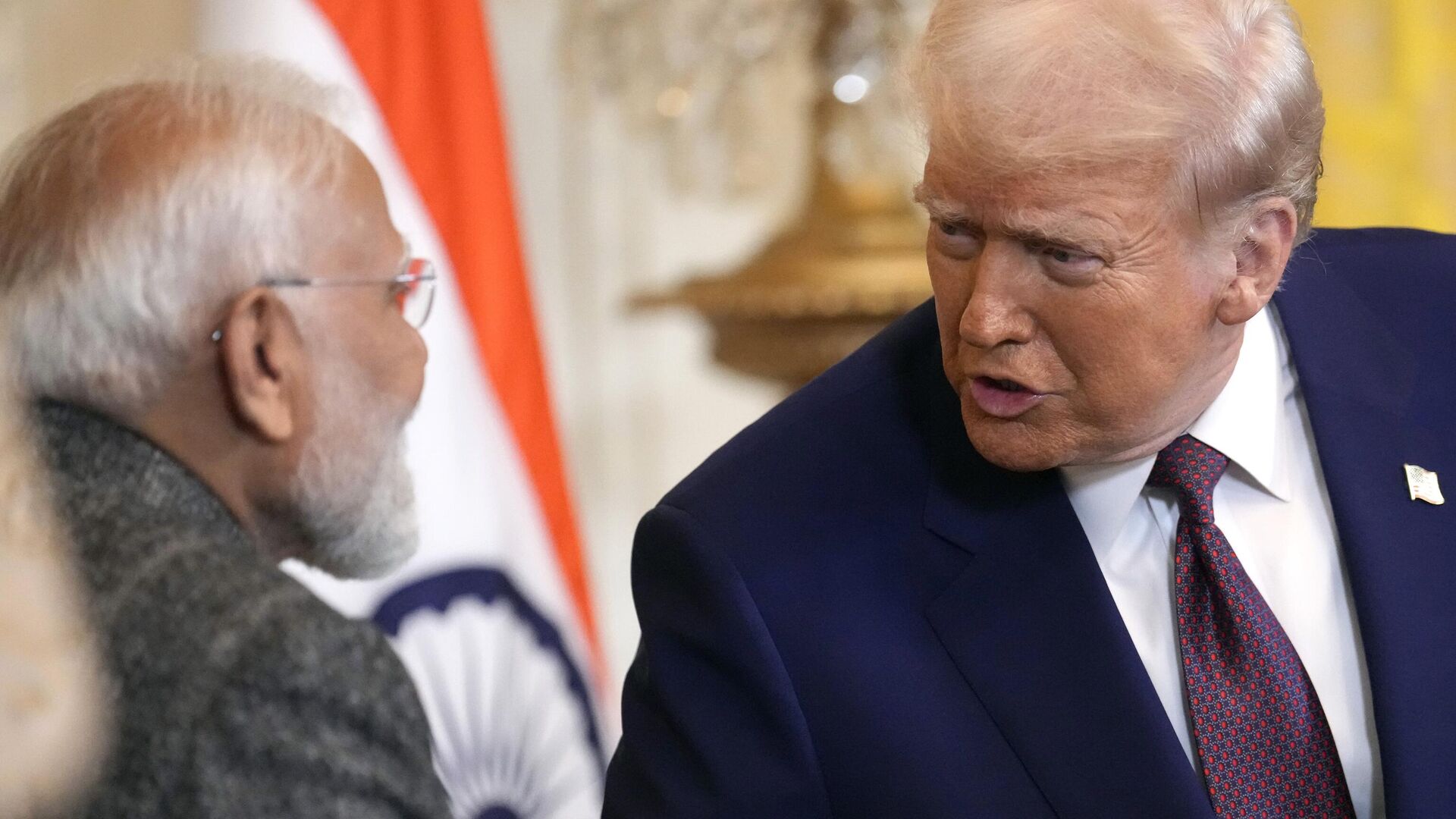
© AP Photo / Ben Curtis
Subscribe

A recent legislation enacted with bipartisan support empowers the administration of President Donald Trump to threaten India over its purchases of Russian energy products.
America's diplomacy of coercion risks a backlash from India, with New Delhi repeatedly demonstrating that it can't be a pawn in US' scheme of things, experts have said.
"There is a risk of a backlash if the US continues its attempts to exert pressure on India over its close energy relationship with Russia. India's response is unlikely to be a simple shift from the United States to Russia, but repeated American use of tariffs and economic pressure will reinforce India's strategic-autonomy instinct," Dr Raj Kumar Sharma, Associate Professor, International Relations at School of Social Sciences, Business and Law, SDU University, Almaty, Kazakhstan, told Sputnik India.
India has demonstrated that it is willing to adjust Russian oil purchases when economic and diplomatic circumstances require it, but it has also shown that it does not want its energy or defence choices dictated externally, he added.
The danger for the US is therefore not necessarily that India will become more aligned with Russia, but that excessive pressure could make India more determined to diversify its partnerships, preserve Russian defence ties and build greater insulation from US economic leverage. In that sense, coercive pressure is likely to strengthen the logic of India's multi-alignment rather than produce the strategic alignment the US seeks, the academic underscored.
"Russian energy could become one component of a broader India-Russia economic relationship rather than merely an oil trade through better prices, financing arrangements, rupee/ruble or other non-dollar settlement mechanisms, long-term contracts and greater downstream cooperation. Russian-origin equipment, maintenance networks, ammunition, spares and technology remain embedded in India's defence ecosystem. India's military relationship with Russia is not easily replaced by tariffs or diplomatic pressure," Sharma asserted.
India's ability to withstand external pressure rests on two mutually reinforcing factors: strong political leadership and growing economic resilience. India's foreign policy has consistently emphasised strategic autonomy - the principle that India's major decisions must ultimately be guided by its own national interest rather than external pressure, he explained.
Political leadership has given this approach greater clarity. On issues such as energy and defence, New Delhi has demonstrated that it is prepared to engage with multiple powers while retaining the freedom to make independent choices. India's continued engagement with Russia, alongside its expanding partnership with the United States, Europe, Japan and the Gulf, illustrates this multi-aligned approach, the strategic affairs pundit reckoned.
"Economic scale also provides India with greater room for maneuver. A large domestic market, relatively strong growth and diversification of trade and investment partnerships mean that India can absorb external shocks better than many developing economies," Sharma stressed.
What has changed is India's ability to diversify its vulnerabilities. India is increasingly building multiple economic, energy and strategic partnerships rather than depending excessively on any single power. This flexibility is India's principal buffer against coercive pressure, he stated.
Meanwhile, Dr Savio Rodrigues, a politician linked with India's federally ruling Bharatiya Janata Party (BJP), believes that India’s relationship with the United States is an important strategic partnership, but it must be built on mutual respect and an understanding of each other’s national interests.
Meanwhile, Dr Savio Rodrigues, a politician linked with India's federally ruling Bharatiya Janata Party (BJP), believes that India’s relationship with the United States is an important strategic partnership, but it must be built on mutual respect and an understanding of each other’s national interests.
"Hence, differences over Russian energy should be addressed through dialogue, not coercion. India’s strategic autonomy allows it to maintain strong relationships with the US, Russia, Europe and the Gulf while safeguarding its own energy and security requirements," Rodrigues underlined in an interview with Sputnik India.
India's political leadership and economic resilience give India the confidence to engage with all major powers without becoming dependent on any one of them. India seeks partnership, not pressure; cooperation, not confrontation, he emphasised.
Another analyst, Dr Indrani Talukdar, a fellow at the New Delhi-based think tank Chintan Research Foundation, argues that no country should seek to dictate another sovereign country’s foreign-policy or economic choices through coercive measures.
The BRICS New Delhi Declaration of September 12, 2026, strongly criticised unilateral coercive measures and sanctions imposed outside the UN Security Council framework. Repeated US pressure through tariffs, sanctions and public criticism could therefore prove counterproductive and affect Washington’s standing in an increasingly multipolar world, she highlighted.
India’s purchases of Russian energy are guided chiefly by energy security, affordability, national interest and market conditions for its 1.4 billion people. Russia also remains significant to India’s defence ecosystem and broader strategic relationship, although New Delhi continues to diversify its defence partnerships and deepen cooperation with the United States and other partners, the think tanker pointed out.
Another analyst, Dr Indrani Talukdar, a fellow at the New Delhi-based think tank Chintan Research Foundation, argues that no country should seek to dictate another sovereign country’s foreign-policy or economic choices through coercive measures.
The BRICS New Delhi Declaration of September 12, 2026, strongly criticised unilateral coercive measures and sanctions imposed outside the UN Security Council framework. Repeated US pressure through tariffs, sanctions and public criticism could therefore prove counterproductive and affect Washington’s standing in an increasingly multipolar world, she highlighted.
India’s purchases of Russian energy are guided chiefly by energy security, affordability, national interest and market conditions for its 1.4 billion people. Russia also remains significant to India’s defence ecosystem and broader strategic relationship, although New Delhi continues to diversify its defence partnerships and deepen cooperation with the United States and other partners, the think tanker pointed out.
"New Delhi is likely to preserve strategic space, maintaining ties with Russia while continuing cooperation with Washington and other partners. The likely consequence of coercive pressure is therefore a stronger determination by India that no external power should dictate its strategic choices," Talukdar observed.
India’s strength lies in combining political resolve with economic resilience. From an Indian perspective, strategic autonomy means engaging the United States as an important partner without allowing any external power to dictate India’s foreign policy or economic choices, she noted.
India’s large domestic market, diversified partnerships and resilient growth provide New Delhi with greater space to withstand external pressure. India has responded to the coercive tactics through diversification, negotiation and domestic capacity-building, the international relations pundit mentioned.
India’s large domestic market, diversified partnerships and resilient growth provide New Delhi with greater space to withstand external pressure. India has responded to the coercive tactics through diversification, negotiation and domestic capacity-building, the international relations pundit mentioned.
"The objective is not to confront the US or align with Russia, but to preserve strategic space. It is to cooperate with the US where interests converge, maintain relations with Russia and other partners where Indian interests require, and ensure that external economic pressure does not determine India’s strategic choices," Talukdar concluded.