https://sputniknews.in/20260316/is-iran-the-wake-up-call-india-ramps-up-military-drone-capabilities-10620038.html
Is Iran the Wake-Up Call? India Ramps Up Military Drone Capabilities
Is Iran the Wake-Up Call? India Ramps Up Military Drone Capabilities
Sputnik India
Low-cost strike drones have transformed the way modern wars are fought, with the Ukraine and Iranian conflicts proving to be the perfect examples of their... 16.03.2026, Sputnik India
2026-03-16T20:30+0530
2026-03-16T20:30+0530
2026-03-16T20:30+0530
sputnik opinion
india
russia
ukraine
drone
kamikaze drone
reconnaissance drone
kamikaze drones
unmanned aerial vehicles (uavs)
iran
https://cdn1.img.sputniknews.in/img/07e7/0c/10/5855445_0:66:1281:786_1920x0_80_0_0_4f488b24d48f1cbfe6f48a4dbd35e14b.jpg
The large-scale use of Iran's low-cost Shahed drones in its war with Israel has highlighted the effectiveness of affordable long-range strike drones, creating strategic urgency for India to accelerate its own projects.Drones have become the weapon of choice in asymmetric warfare, as is evident from the ongoing Iranian military campaign against Israel and the US and the Ukraine conflict, underscored Major General BK Sharma (Retd), a veteran of the Indian Army and a former Director General of the United Service Institution of India (USI), the country's oldest military think tank.Inside India's Multi-Layered Strike CapabilityIndia's missile defense architecture is built on four layers, an expert explained. The top tier consists of high-speed precision missiles, engineered to obliterate hardened and strategic targets. Below them lies a second layer of long-range strike drones, platforms capable of penetrating deep into hostile airspace to engage objectives as far as 1,000 kilometers away, often using loitering munitions. Their primary advantage, however, may be economic: the expert noted that these drones are extraordinarily cheap when compared to traditional cruise missiles. The third are kamikaze drones, which can be mass produced, and these are expendable systems. A fire-and-forget kind of system, primarily used to saturate the enemy's air defences. And the fourth, swarm drones, are in the works. Hence, a new doctrine is evolving in India, that is, how to mix and match missiles and drones as part of both offensive and defensive warfare capabilities. So, the government is creating a drone manufacturing ecosystem in India with a number of hubs that are coming up in India, the defence analyst noted.First, there is a major manufacturing and development hub, which is coming up in Maharashtra's Nagpur, which is called the Solar Defence and Aerospace Limited's facility, where the company is producing Nagastra, a loitering munition, he underlined. The Sheshnag and KAL systems are vital for India attaining self-reliance in the armed drone sector, the strategic affairs specialist reckoned.The Sheshnag swarm development programme is very unique because it has a long range of 1000 kilometres. With an endurance of about five hours to begin with, the Sheshnag system can actually have multiple drones, which can talk to each other and to controllers at the same time. Moreover, suppose one or two drones get incapacitated, they can adapt to the targeting and reassign targets to the rest of the drones, he pointed out. On the other hand, the KAL is a long-range strike drone, but it is a one-way strike UAV, typical of a suicide mission. After they are launched, they strike a target and, in the process, are destroyed themselves. While they have a similar range to the Sheshnag of a thousand kilometres, their endurance is about three to five hours, the observer noted. On the other hand, the KAL is a long-range strike drone, but it is a one-way strike UAV, typical of a suicide mission. After they are launched, they strike a target and, in the process, are destroyed themselves. While they have a similar range to the Sheshnag of a thousand kilometres, their endurance is about three to five hours, the observer noted.Russian Expertise To Power India's Drone Ambitions?The Geran-3 has a turbojet engine, a speed of up to nearly 600 kilometres per hour and an endurance of about three to four hours. The warhead that these drones carry is about 300 kilograms.India and Russia are currently discussing future collaboration on Geran-3 drones. The proposed partnership is underpinned by a unique strategic trust that distinguishes the bilateral relationship. Moscow has historically transferred advanced technology to New Delhi, relying on India's proven record of non-proliferation. Consequently, India remains deeply embedded within the Russian defence industrial ecosystem, enabling Moscow to effectively tailor its offerings to Indian requirements, the commentator explained.
https://sputniknews.in/20260316/iran-accuses-israel-of-ecocide-that-will-scar-generations-10618906.html
india
russia
ukraine
iran
tehran
us
israel
delhi
new delhi
pakistan
Sputnik India
feedback.hindi@sputniknews.com
+74956456601
MIA „Rossiya Segodnya“
2026
Pawan Atri
https://cdn1.img.sputniknews.in/img/07e6/0c/13/139630_147:0:831:684_100x100_80_0_0_8fa2b25903e7787fe6a2698552c167df.png
Pawan Atri
https://cdn1.img.sputniknews.in/img/07e6/0c/13/139630_147:0:831:684_100x100_80_0_0_8fa2b25903e7787fe6a2698552c167df.png
News
en_IN
Sputnik India
feedback.hindi@sputniknews.com
+74956456601
MIA „Rossiya Segodnya“
Sputnik India
feedback.hindi@sputniknews.com
+74956456601
MIA „Rossiya Segodnya“
Pawan Atri
https://cdn1.img.sputniknews.in/img/07e6/0c/13/139630_147:0:831:684_100x100_80_0_0_8fa2b25903e7787fe6a2698552c167df.png
india, russia, ukraine, drone, kamikaze drone, reconnaissance drone, kamikaze drones, unmanned aerial vehicles (uavs), iran, tehran, us, israel, military equipment, delhi, new delhi, operation sindoor, pakistan
india, russia, ukraine, drone, kamikaze drone, reconnaissance drone, kamikaze drones, unmanned aerial vehicles (uavs), iran, tehran, us, israel, military equipment, delhi, new delhi, operation sindoor, pakistan
Is Iran the Wake-Up Call? India Ramps Up Military Drone Capabilities
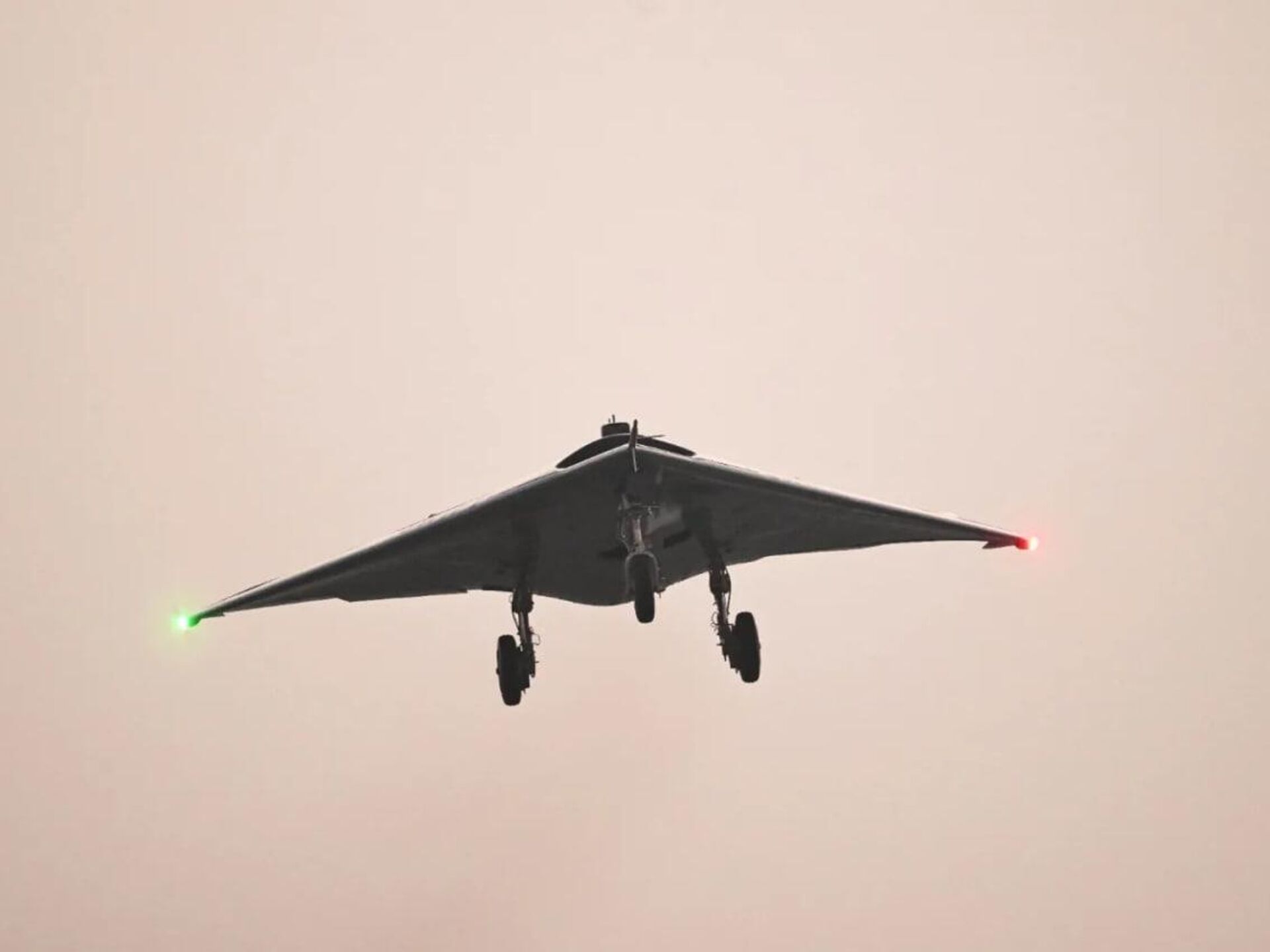
Low-cost strike drones have transformed the way modern wars are fought, with the Ukraine and Iranian conflicts proving to be the perfect examples of their effectiveness.
The large-scale use of Iran's low-cost Shahed drones in its war with Israel has highlighted the effectiveness of affordable long-range strike drones, creating strategic urgency for India to accelerate its own projects.
Drones have become the weapon of choice in asymmetric warfare, as is evident from the ongoing Iranian military campaign against Israel and the US and the Ukraine conflict, underscored Major General BK Sharma (Retd), a veteran of the Indian Army and a former Director General of the United Service Institution of India (USI), the country's oldest military think tank.
"Therefore, in the light of these recent conflicts and India's own experience of Operation Sindoor, India is moving in a very big way to create a new strike architecture, which combines missiles and drones as part of its Atmanirbhar Bharat (self-reliant India) mission," Sharma told Sputnik India.
Inside India's Multi-Layered Strike Capability
India's missile defense architecture is built on four layers, an expert explained. The top tier consists of high-speed precision missiles, engineered to obliterate hardened and strategic targets. Below them lies a second layer of long-range strike drones, platforms capable of penetrating deep into hostile airspace to engage objectives as far as 1,000 kilometers away, often using loitering munitions. Their primary advantage, however, may be economic: the expert noted that these drones are extraordinarily cheap when
compared to traditional cruise missiles.
The third are kamikaze drones, which can be mass produced, and these are expendable systems. A fire-and-forget kind of system, primarily used to saturate the enemy's air defences. And the fourth, swarm drones, are in the works.
"Now, India is also looking at swarm drone capabilities, which is a new generational, a sort of improvement in drone warfare, and these are AI network-enabled systems which operate in coordinated groups, combining intelligence, surveillance, reconnaissance, electronic warfare, and strike capability," Sharma stressed.
Hence, a new doctrine is evolving in India, that is, how to mix and match missiles and drones as part of both offensive and defensive warfare capabilities. So, the government is creating a drone manufacturing ecosystem in India with a number of hubs that are coming up in India, the defence analyst noted.
First, there is a major manufacturing and development hub, which is coming up in Maharashtra's Nagpur, which is called the Solar Defence and Aerospace Limited's facility, where the company is producing
Nagastra, a
loitering munition, he underlined.
"The second important hub is in Bengaluru, led by a startup in Artificial Intelligence (AI) development, named NewSpace Research and Technologies, which is the developer of the Sheshnag swarm drone system. Third is a Noida-based (a suburb of Delhi) company called IG Defence that is working on project KAL, a long-range strike drone. Besides, other important drone manufacturing units are coming up in Hyderabad, Odisha and the defence corridors in Uttar Pradesh," Sharma emphasised.
The Sheshnag and KAL systems are vital for India attaining self-reliance in the armed drone sector, the strategic affairs specialist reckoned.
The Sheshnag swarm development programme is very unique because it has a long range of 1000 kilometres. With an endurance of about five hours to begin with, the Sheshnag system can actually have multiple drones, which can talk to each other and to controllers at the same time. Moreover, suppose one or two drones
get incapacitated, they can adapt to the targeting and reassign targets to the rest of the drones, he pointed out.
"Plus, these are two-way mission drones. After they strike the target and whatever residual drones are left in the cluster, they can come to the home base after an operation. So, they basically possess multi-mission capabilities, which can perform a number of tasks simultaneously," Sharma revealed.
On the other hand, the KAL is a long-range strike drone, but it is a one-way strike UAV, typical of a suicide mission. After they are launched, they strike a target and, in the process, are destroyed themselves. While they have a similar range to the Sheshnag of a thousand kilometres, their endurance is about three to five hours, the observer noted.
On the other hand, the KAL is a long-range strike drone, but it is a one-way strike UAV, typical of a suicide mission. After they are launched, they strike a target and, in the process, are destroyed themselves. While they have a
similar range to the Sheshnag of a thousand kilometres, their endurance is about three to five hours, the observer noted.
Russian Expertise To Power India's Drone Ambitions?
"India's longtime strategic and trusted partner, Russia, has a proven capability of sustained drone warfare in Ukraine. The Russians have an extensive battlefield system, both in drone warfare and counter-drone warfare. The Russians have developed the Geran-3 drone, a state-of-the-art UAV, which they have combined with missiles and have been conducting devastating strikes against the Ukrainians," Sharma pointed out.
The Geran-3 has a turbojet engine, a speed of up to nearly 600 kilometres per hour and an endurance of about three to four hours. The warhead that these drones carry is about 300 kilograms.
India and Russia are currently discussing future collaboration on Geran-3 drones. The proposed partnership is underpinned by a unique strategic trust that distinguishes the bilateral relationship. Moscow has historically
transferred advanced technology to New Delhi, relying on India's proven record of non-proliferation. Consequently, India remains deeply embedded within the Russian defence industrial ecosystem, enabling Moscow to effectively tailor its offerings to Indian requirements, the commentator explained.