Can India Achieve Self-Reliance in Critical Technologies by 2047?
© Photo : MoD / https://mod.gov.in/
Subscribe

India has made great progress in indigenous missile technology, several critical technologies associated with submarines and fighter jets, like engines and Air-independent propulsion (AIP) continue to evade the nation.
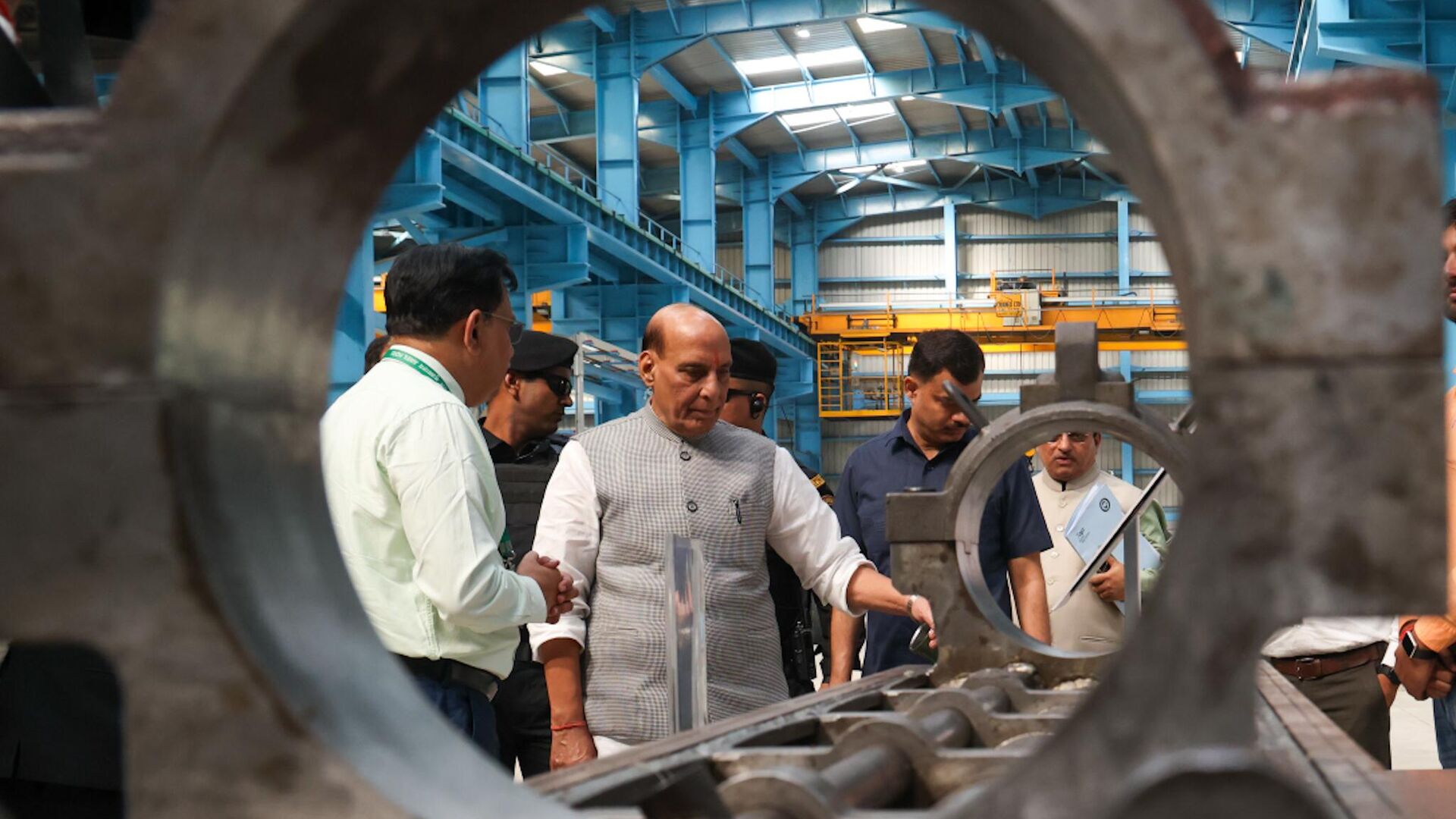
Defence Minister Rajnath Singh on Tuesday said that India has to achieve self-reliance in critical technologies by 2047, underlining that true sovereignty will only be achieved through independence in the defence sector.
"By 2047, we have to achieve self-reliance in critical technologies, significant increase in indigenous content, multi-fold growth in defence exports, and we will have to ensure strong presence of India in global supply chain," Singh said in his address during a Defence Research and Development Organisation (DRDO) organised event in New Delhi.
While India has certainly travelled a long way towards defence self-reliance, one needs to distinguish between self-reliance in defence manufacturing and self-reliance in critical technologies. These are not necessarily the same thing, an analyst reckoned.
The numbers show substantial progress. India's defence production reached a record INR 1.78 lakh crore ($18.56 billion) in 2025–26, compared with INR 84,643 crore ($8.83 billion) in 2020–21. Defence exports have also reached INR 38,424 crore ($4 billon), while the government estimates that nearly 65 per cent of defence equipment is now produced domestically.
"But the real challenge lies one level deeper. India can manufacture an aircraft, warship or missile domestically while still depending on foreign suppliers for some of its most important components. These include areas such as aero-engines, certain advanced materials, propulsion technologies, high-end sensors and electronic components. That is where technological sovereignty really becomes important," Namita Barthwal, a Research Analyst at the Military Affairs Centre of the Manohar Parrikar Institute for Defence Studies and Analyses (MP-IDSA), told Sputnik India.
"A second problem is that critical technologies require decades of sustained investment. Jet engines, for example, involve metallurgy, single-crystal turbine blades, thermal coatings, high-pressure compressors and extremely precise manufacturing. You cannot simply inject money into such a programme today and expect a world-class engine five years later. It requires continuous experimentation, testing and even tolerance for failure," Barthwal added.
Take fighter aircraft. India has successfully designed the Tejas, but its propulsion continues to depend on American GE engines. The Tejas Mk1 uses the F404 family, while the Mk2 is planned around the more powerful F414, she underscored.
India and GE have pursued an arrangement to manufacture the F414 in India, with around 80 per cent technology transfer. This itself demonstrates the difficulty involved: designing the airframe is a major achievement, but mastering the engine is another technological challenge altogether, the expert noted.
"A second problem is that critical technologies require decades of sustained investment. Jet engines, for example, involve metallurgy, single-crystal turbine blades, thermal coatings, high-pressure compressors and extremely precise manufacturing. You cannot simply inject money into such a programme today and expect a world-class engine five years later. It requires continuous experimentation, testing and even tolerance for failure," Barthwal added.
India, therefore, also needs to strengthen its R&D ecosystem. DRDO's allocation has risen from ₹26,816.82 crore ($2.80 billion) in 2025–26 to ₹29,100.25 ($3.03) crore in 2026–27, while around 25 per cent of the defence R&D budget has been opened to industry, start-ups and academia. Fifteen DRDO-Industry-Academia Centres of Excellence covering 82 research verticals have also been established, she emphasised.
The third challenge is converting research into mass production. India has historically had strong government laboratories and defence PSUs, but future technologies will require much deeper participation by private companies, MSMEs, universities and start-ups. The private sector currently accounts for about 24 per cent of India's defence production, so there is considerable room for expansion, the think tanker explained.
"Self-reliance should not mean trying to manufacture every nut and bolt in India. No major military power operates completely independently of global supply chains. The objective should instead be to identify technologies whose denial during a conflict could seriously affect India's military capability," Barthwal stated.
For technologies such as aero-engines and submarine propulsion, the more practical strategy is a combination of the two: collaborate where collaboration can shorten the technological learning curve, but structure that partnership so that India eventually acquires the ability to design the next generation independently, she stressed.
Missile technology provides an interesting contrast. India has developed considerable indigenous capability through programmes such as Agni, Akash, Astra and the broader Integrated Guided Missile Development Programme. In August 2026, the government even approved transfer of DRDO-developed technologies for all conventional missile systems to the Indian industry for domestic production, the defence pundit pointed out.
"Jet engines are different because the technological barriers are extraordinarily high. India's Kaveri programme generated considerable knowledge and infrastructure but did not ultimately produce the engine required for the Tejas. This is why I would favour co-development rather than simple licensed production," Barthwal underlined.
There is an important distinction here. If a foreign company gives India drawings and allows an Indian company to manufacture an engine, India has gained manufacturing capability. But if Indian engineers understand the design methodology, materials, hot-section technology, manufacturing processes, testing and performance optimisation, India has acquired technological capability. That should be the objective, she mentioned.
India should therefore negotiate partnerships around four things: design knowledge, manufacturing know-how, intellectual-property rights and the freedom to modify and upgrade the system. Complete ownership of every piece of pre-existing foreign IP may not always be commercially realistic. A more important goal is Indian ownership, or clearly defined joint ownership, of the intellectual property created through a new co-development programme, the military commentator remarked.
"The same principle applies to submarines. India has already developed a fuel-cell-based indigenous AIP system through DRDO's Naval Materials Research Laboratory. Its land-based prototype was successfully tested, and India has been working with France's Naval Group on detailed design and integration into the Kalvari-class submarines. DRDO currently says work is progressing on the energy modules and detailed design of the AIP plug," Barthwal said.
That is actually a useful model: develop the core technology domestically and use a foreign partner where specialised integration or certification experience is required, she suggested.
At the same time, India should continue independent R&D even when foreign technology is available. The Kaveri experience should not simply be seen as a failure. The technological ecosystem created around it is now contributing to other programmes, the specialist observed.
In February 2026, GTRE demonstrated a full-afterburner test of the Kaveri engine, and in July, an indigenous 350-kg-thrust-class expendable turbojet engine developed by GTRE was manufactured and delivered by an Indian private company.
"Hence, I would describe the strategy as 'collaborate to accelerate, but develop to become autonomous.' Foreign collaboration can save India decades of trial and error, but every collaboration should leave Indian industry and scientists capable of doing more independently on the next programme, Barthwal commented.
The ultimate objective should not merely be to say that an engine or submarine was made in India. It should be that the next generation can be designed in India, modified in India and upgraded in India without external technological dependence, she asserted.
So, the real test of Aatmanirbharta is quite simple: Can India design, manufacture, repair, modify and upgrade its most important military systems without requiring another country's permission? If India can achieve that in propulsion, sensors, advanced materials, electronics, AI, cyber and space technologies, the 2047 objective would represent genuine technological sovereignty rather than simply higher domestic production, the observer summed up.